


November 12, 2026
Doug Stone
November 14, 2026
,
Doug Stone
Which Grain Free Cat Food Brands Are Worth Buying?
Last Updated: November 14, 2026
Quick Summary
The best grain free cat food brands depend on your cat's age, digestion, and whether you want kibble or wet food. Our top dry picks are Acana Indoor Entree for indoor adults, Merrick Purrfect Bistro for sensitive stomachs, Instinct Ultimate Protein for high protein, and Stella & Chewy's Raw Blend for raw-coated kibble.
- Every formula we pick carries a complete and balanced AAFCO nutritional adequacy statement for its life stage.
- Grain-free simply swaps grains for peas, lentils, chickpeas, or sweet potato and is not automatically better.
- Grain allergies are rare in cats; most food sensitivities trace to a protein like chicken, beef, or fish.
- Transition over seven days, starting at 75% old food and 25% new food.
- Merrick Purrfect Bistro has the lowest daily cost in our dry group at roughly $0.80 to $1.00.
Not sure which grain-free food fits your cat?We stock trusted grain-free cat food brands and help you pick the right one.
Shop Grain Free Cat Food
Table of Contents
- Quick Comparison: Best Grain Free Cat Food Brands
- How We Chose These Grain Free Cat Food Brands
- Grain-Free Cat Food Pros and Cons: What Pet Parents Should Know
- Best Grain-Free Dry Cat Food Picks
- Best Grain-Free Wet Cat Food and How to Add Moisture
- How to Transition Cats to New Food Safely
- Choosing the Right Grain Free Cat Food at The Family Pet
- Frequently Asked Questions
Quick Comparison: Best Grain Free Cat Food Brands
If you're shopping for the best grain free cat food brands, the short answer is this: the right pick depends on your cat's age, digestion, and whether you want kibble, wet food, or a mix of both. At The Family Pet, we've narrowed our shelf down to a handful of grain free cat food formulas we genuinely trust.
Here's the lineup at a glance:
| Product | Type | Price | Best For |
|---|---|---|---|
| Acana Indoor Entree | Dry | $32.99 | Indoor cats watching their weight |
| Merrick Purrfect Bistro Salmon & Sweet Potato | Dry | $22.99 | Sensitive stomachs on a budget |
| Instinct Ultimate Protein Chicken | Dry | $41.99 | High-protein, no animal meal |
| Stella & Chewy's Raw Blend Poultry | Dry | $24.99 | Raw-coated kibble lovers |
Price
Acana Indoor Entree $32.99
Merrick Purrfect Bistro Salmon & Sweet Potato $22.99
Instinct Ultimate Protein Chicken $41.99
Stella & Chewy's Raw Blend Poultry $24.99
Below, we'll walk through how we chose these, what grain-free really means for cats, and how to switch foods without a messy week.
How We Chose These Grain Free Cat Food Brands
We didn't just grab whatever had the prettiest bag. Our criteria were simple and consistent.
First, every formula here is complete and balanced for its stated life stage. That's the baseline, not a bonus. Second, we looked at where the protein comes from. Third, we weighed value against bag size, because a premium price means nothing if your cat turns their nose up at it.
A common mistake is chasing the trendiest label instead of matching the food to the cat in front of you.
If you want a plain-language primer on what separates premium ingredients from filler, our guide to premium pet food ingredients breaks it down without the jargon.
Grain-Free Cat Food Pros and Cons: What Pet Parents Should Know
Grain-free cat food isn't automatically better. It simply means the recipe skips wheat, corn, rice, barley, and similar grains, and usually replaces them with peas, lentils, chickpeas, or sweet potato.
Here's the honest breakdown, in plain terms.
What grain-free actually changes. Grains are a carbohydrate source.
The real pros.
- More animal-based protein is common. Many grain-free recipes lead with named meats like chicken, salmon, or turkey, which matches a cat's natural carnivore profile better than a grain-heavy kibble.
- Fewer filler carbs in some formulas. If your cat does better on a lower-carbohydrate diet, grain-free options often (not always) fit that bill.
- A useful starting point for elimination trials. If your vet suspects a grain sensitivity, which is far less common in cats than a protein sensitivity, a grain-free formula can be one piece of a structured trial.
The real cons.
- Grain-free does not mean carb-free. Peas, lentils, and potato are still carbohydrates. A grain-free bag can carry just as many carbs as a grain-based one.
- Grain allergies are rare in cats. Most food sensitivities in cats trace to a protein, usually chicken, beef, or fish, not to wheat or corn. If your cat has a diagnosed sensitivity, a limited-ingredient diet built around a novel protein is usually the better path, and Instinct Limited Ingredient Rabbit is one limited-ingredient option for that purpose.
- Grain-free is not a treatment. It is a dietary preference or a piece of a vet-guided plan, not a cure for itching, vomiting, or loose stool on its own.
- Legume-heavy formulas deserve a closer look. Some grain-free recipes lean heavily on peas and lentils to hit their protein numbers. That's not automatically bad, but it's worth knowing what you're buying.
How to tell a marketing claim from a nutritional one. Flip the bag over.
When a vet would actually recommend grain-free. Most practitioners reach for grain-free only in two situations: a confirmed grain sensitivity (rare), or as part of a broader elimination diet where the vet is controlling every variable. Outside those cases, a complete-and-balanced food with grains is perfectly appropriate for most cats.
Watch out: if your cat has a diagnosed health condition, is pregnant or nursing, or is a growing kitten, talk to your vet before changing diets, grain-free or otherwise.
The takeaway: grain-free is a dietary preference, not a cure-all, and the nutritional adequacy statement matters more than the grain-free badge.
Best Grain-Free Dry Cat Food Picks
Here's where the rubber meets the kibble. These four dry foods are our current favorites, and each one earns its spot for a different reason. Before the picks, here's the scoring we applied so you can judge them the same way we did.
Our scoring criteria (each worth up to 5 points, 30 total):
- Nutritional adequacy. Does the bag carry a clear AAFCO nutritional adequacy statement, and does the named life stage match the cat you're feeding?
- Protein sourcing. Are the first ingredients named meats (chicken, salmon, turkey) rather than vague meals or plant proteins?
- Carbohydrate load. Where are the carbs coming from, peas, lentils, potato, tapioca, and roughly how much of the formula do they represent?
- Manufacturing transparency. Does the brand state who makes the food and where?
- Recall history. Has the brand had recent, relevant recalls on this product line?
- Cost per day. Package price divided by realistic daily feeding amount for a 10-pound cat, not price per pound.
A perfect score is rare. A score in the low-to-mid 20s is a strong pick.
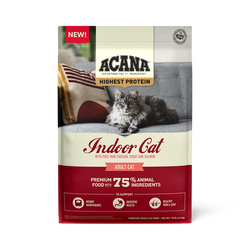
Acana Adult Grain Free Chicken, Trout and Salmon Indoor Entree
Our top pick for indoor cats. Acana packs this recipe with protein-rich animal ingredients, chicken, trout, and salmon, and balances calories from protein and fat to help indoor cats hold a healthy weight. It's made in the USA. Best for: indoor adult cats who need portion-friendly nutrition. Skip if: your cat prefers fish-free flavors. Cost per day: roughly $1.10-$1.30 for a 10-pound cat at typical feeding amounts, based on the $32.99 bag size.
Check out the Acana Indoor Entree details and pricing
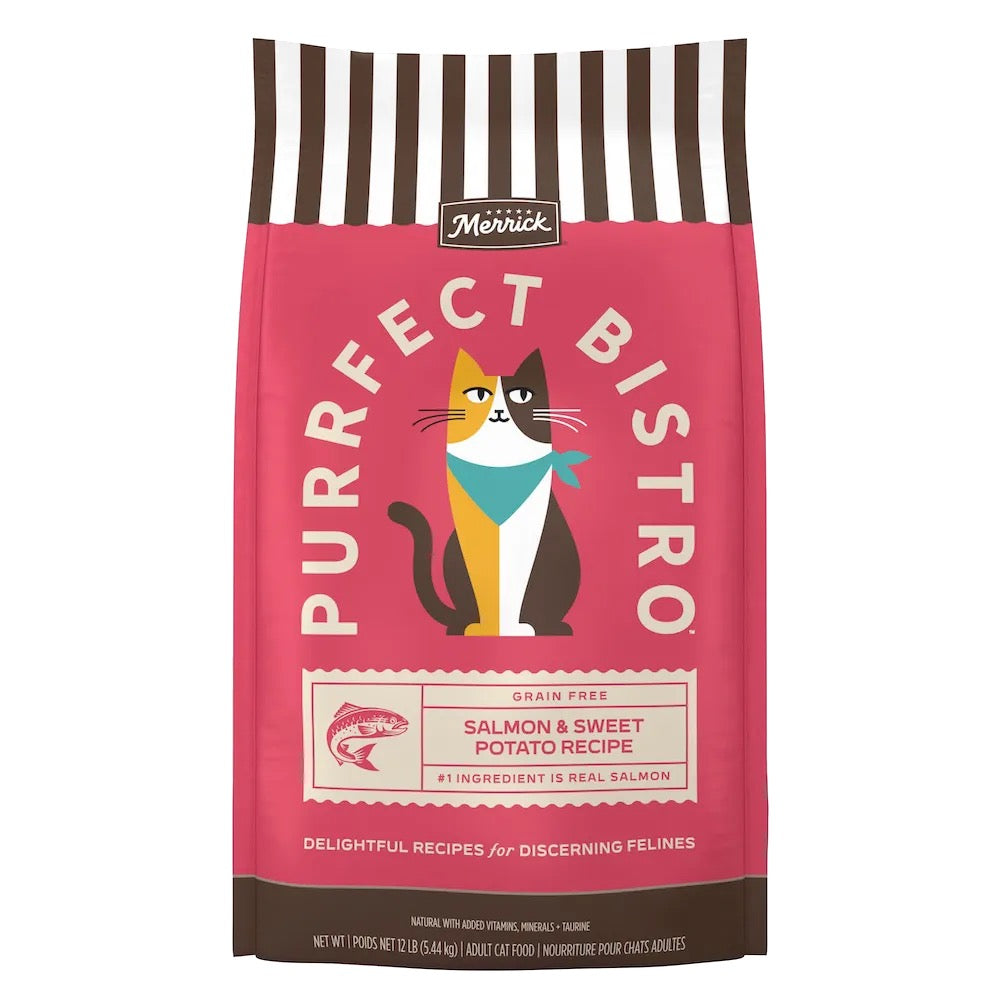
Merrick Purrfect Bistro Salmon & Sweet Potato
Real salmon leads the ingredient list, with sweet potatoes and omega fatty acids for skin and coat. This one is described as easily digestible, and at $22.99 for a 4-pound bag it's the value leader here. Best for: cats with touchy digestion. Skip if: your cat turns up their nose at fish. Cost per day: roughly $0.80-$1.00 for a 10-pound cat, making it the lowest daily cost in this group.
See the Merrick Purrfect Bistro formula
Instinct Ultimate Protein All Life Stages Chicken
This is the high-protein heavyweight. Instinct sources its protein from real chicken with no animal meal, plus guaranteed levels of live, natural probiotics. It is an all life stages formula. Best for: active cats and multi-cat homes. Skip if: you want the lowest price per pound. Cost per day: roughly $1.40-$1.60 for a 10-pound cat, the highest in this group, you're paying for the protein density.
View the Instinct Ultimate Protein product page
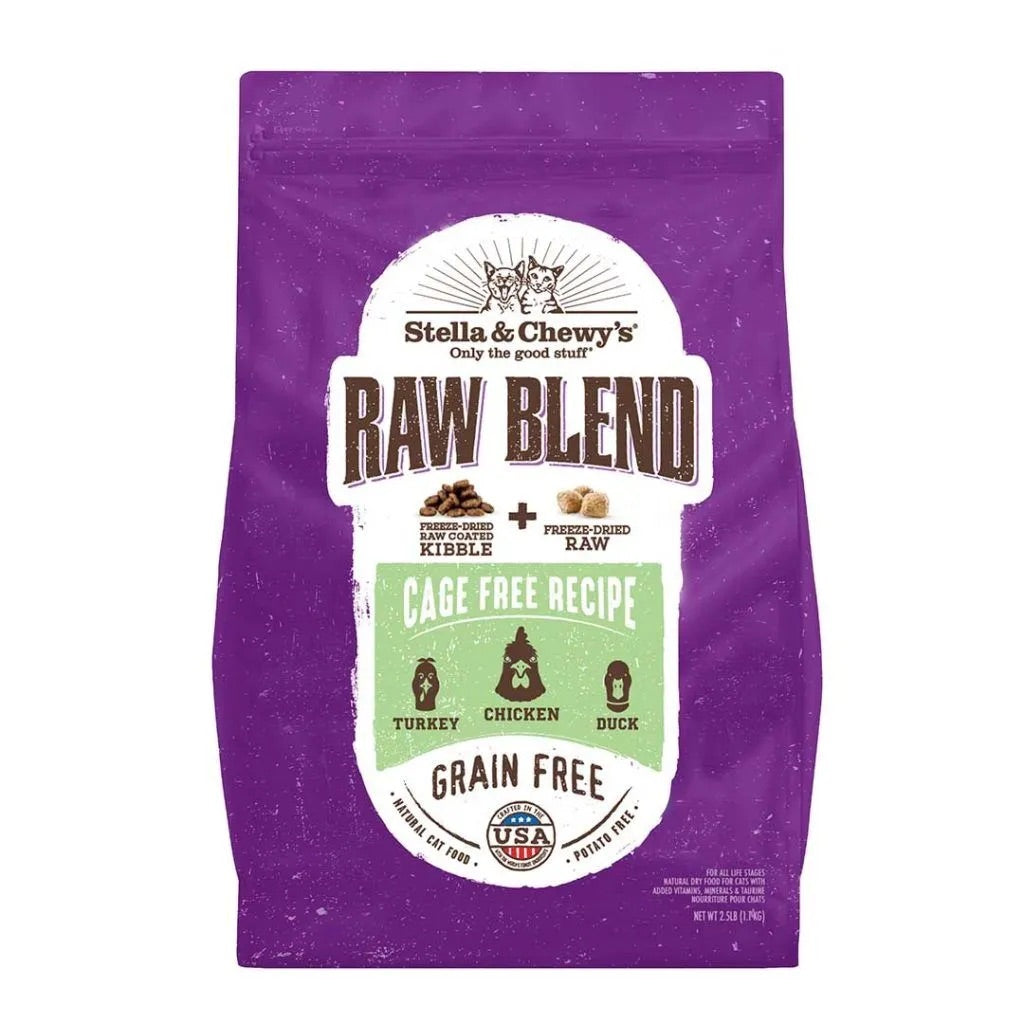
Stella & Chewy's Raw Blend Poultry
Kibble coated in freeze-dried raw chicken, plus a blend of cage-free chicken, turkey, and duck.
Explore Stella & Chewy's Raw Blend
How to use this list. If your cat is a healthy indoor adult and you want one bag that does the job, start with Acana. If digestion is the concern, Merrick is the gentler and cheaper entry point.
Watch out: cost per day shifts with your cat's weight and activity level, and a 10-pound cat is just a reference point.
Best Grain-Free Wet Cat Food and How to Add Moisture
Cats are famously bad at drinking enough water, and dry food alone can leave them running a little dry. The fix is simple: add moisture.
Adding a quality grain-free wet food, or a splash of water or broth mixed into kibble, adds moisture to your cat's meals. Several of our dry picks, including Stella & Chewy's and Rawz, recommend adding moisture to meals. A practical habit: mix a spoonful of wet food or a little warm water into the bowl and let it sit a minute before serving.
If your cat is a committed kibble fan, start small. A teaspoon of moisture at first, then build up as they accept it.
How to Transition Cats to New Food Safely
Never switch foods overnight. A sudden change can upset your cat's stomach, and nobody wants that cleanup.
Here's the schedule we recommend:
- Days 1-2: 75% old food, 25% new food.
- Days 3-4: 50/50 split.
- Days 5-6: 25% old food, 75% new food.
- Day 7 onward: 100% new food.
Watch the litter box during the switch. A healthy stool should be formed but soft. If things go sideways, slow down and stretch the timeline. Stella & Chewy's suggests a 7-10 day transition.
Choosing the Right Grain Free Cat Food at The Family Pet
Picking a grain free cat food comes down to matching the recipe to your cat, not chasing a label. Start with life stage, factor in digestion and protein preference, and always transition slowly.
That's where we come in. The Family Pet is a family-owned store, and our team genuinely knows these formulas because we stock and talk about them every day.
Still not sure which bag to grab? Stop in or reach out, and we'll help you find the right fit for your cat.
Your cat deserves food you feel good about, and the right formula can make a real difference in how they look and feel.
Frequently Asked Questions
Is grain-free cat food actually good for cats?
Grain-free food can be a good fit for some cats, especially those with food sensitivities to grains like wheat or corn. It swaps grains for other carbohydrate sources such as peas, lentils, or sweet potatoes. The key is picking a recipe that is complete and balanced and rich in animal protein. Grain-free is not automatically healthier for every cat, so talk with your vet about your cat's specific needs before switching.
Why don't some vets recommend grain-free cat food?
Some vets are cautious because grain-free does not mean carbohydrate-free, and a few grain-free diets have been linked to heart concerns in dogs. For most healthy cats, grains are not a problem unless there is a diagnosed allergy. Your vet may prefer a diet with proven nutritional adequacy for your cat's life stage. It is always best to ask your vet before making a big diet change, especially if your cat has health issues.
What should I look for in grain free cat food?
Start with the first few ingredients: you want a named animal protein like chicken, salmon, or rabbit at the top. Check that the label says complete and balanced and meets AAFCO nutrient profiles for your cat's life stage. Look for taurine, omega fatty acids, and added vitamins and minerals. Avoid artificial colors and preservatives when you can, and match the food to your cat's age, weight, and activity level.
How should I switch my cat to a grain-free food?
Transition slowly over 7 to 10 days. Mix a small amount of the new food with your cat's current food and gradually increase the new food while decreasing the old. Watch for changes in stool, appetite, and energy. If your cat has a sensitive stomach, stretch the transition to two weeks. Sudden switches can cause digestive upset, so patience pays off.
Can kittens eat grain-free cat food?
Yes, but only if the food is labeled for all life stages or specifically for kittens. Kittens need more calories, protein, and certain nutrients than adult cats, so a food formulated only for adult maintenance is not enough. Look for an all-life-stages grain-free recipe, such as Stella & Chewy's Raw Blend Poultry or Rawz Limited Ingredient Rabbit, and follow the feeding guidelines for kittens.


Leave a comment