


October 21, 2026
Doug Stone
October 23, 2026
,
Doug Stone
Raw Diet Benefits for Cats: What to Know Before You Switch
Last Updated: October 23, 2026
Quick Summary
Raw diet benefits for cats that owners most often report are smaller, less pungent stools, a glossier coat, and a stronger appetite. These are observations rather than guarantees, and they vary enormously from cat to cat. Raw feeding also costs more per meal and puts the safety burden on you.
- Switch slowly over seven to ten days, starting with about a quarter raw mixed into the current food.
- Raw meat can carry Salmonella and Listeria, so wash hands, bowls, counters, and utensils with hot soapy water after every feeding.
- Taurine deficiency causes heart and vision problems, and homemade recipes often run short on it.
- Weigh your cat monthly on a baby scale and use a body condition score chart from your vet.
- Cats with chronic conditions, kittens, and seniors should see a vet before any diet change.
Table of Contents
- Raw Diet Benefits for Cats: What Owners Actually Notice
- Raw Cat Food Pros and Cons, Weighed Honestly
- Digestion, Stool Quality, and Litter-Box Habits
- Raw Food Diet Risks for Cats You Should Not Skip
- Homemade Raw Cat Food Nutrition: Getting It Complete and Balanced
- How to Transition a Cat to Raw Food Without a Mess
- Teeth, Coat, Weight, and Energy: Grading the Evidence
- Conclusion
- Frequently Asked Questions
Raw Diet Benefits for Cats: What Owners Actually Notice
If you've spent any time in cat forums lately, you've seen the claims: shinier coats, smaller poops, more energy. Raw diet benefits for cats get talked about like a magic trick. Here at The Family Pet, we talk to cat parents every day who are curious but cautious, and that's exactly the right posture.
Watch Out
The biggest mistake we see is switching cold turkey overnight. Cats have sensitive digestive systems, and an abrupt change often means vomiting or diarrhea within 48 hours. Slow transitions prevent most of that misery.
Raw Cat Food Pros and Cons, Weighed Honestly
The raw cat food pros and cons come down to one trade-off: you may gain tighter control over what's in the bowl, but you take on more responsibility for safety and completeness.

Where Raw Feeding Tends to Help
Owners most often report improvements in three areas: stool quality, coat condition, and appetite. Many tell us their cat's litter box output got smaller and less pungent within a few weeks, and others notice a glossier coat. These are observations, not guarantees, and they vary enormously from cat to cat.
Where It Falls Short
Raw feeding costs more per meal than most commercial food, takes freezer space, and requires real attention to hygiene. Homemade recipes can be nutritionally incomplete if you're guessing at ratios. And cats with certain health conditions should not switch without veterinary sign-off.
| Factor | Raw Feeding | Commercial Food |
|---|---|---|
| Cost per meal | Higher | Lower |
| Prep time | Daily effort | Open and serve |
| Stool volume | Often smaller | Typically larger |
| Safety burden | On you | On the manufacturer |
| Nutritional control | High, if done right | Built in |
Digestion, Stool Quality, and Litter-Box Habits
Digestibility is the benefit owners notice first.
A cat producing smaller, firmer stools is usually absorbing more of what it eats.
Watch appetite closely. A cat who refuses food for more than a day is at risk, and inappetence in cats can escalate quickly. Keep the old food on hand during any transition.
Raw Food Diet Risks for Cats You Should Not Skip
Raw food diet risks for cats are real, and the honest ones fall into two buckets: pathogens and nutrition. Raw meat can carry Salmonella, Listeria, and other bacteria (the FDA). Cats are more resistant than humans, but they can still shed bacteria in their stool, which matters in households with kids, elderly family members, or anyone immunocompromised.
A homemade recipe built from guesswork can run short on calcium, taurine, or vitamin A. Taurine deficiency in particular causes heart and vision problems in cats, and it's not something you'll spot in a week.
Bacteria, Cross-Contamination, and Household Safety
Cross-contamination is the risk most owners underestimate. The fix is a simple, non-negotiable household protocol:
- Designate one cutting board and one knife for raw pet food only
- Wash hands, bowls, counters, and utensils with hot soapy water after every feeding
- Thaw raw food in the fridge, never on the counter
Pro Tip
Keep a dedicated spray bottle of disinfectant near the prep area. The friction of hunting for cleaning supplies is what makes people skip the wipe-down.
Homemade Raw Cat Food Nutrition: Getting It Complete and Balanced
Homemade raw cat food nutrition is where most DIY efforts go wrong. Cats are obligate carnivores, meaning they need certain nutrients from animal sources in certain ratios, and "complete and balanced" is a legal and technical phrase, not a vibe. It means the recipe meets established nutrient profiles for the cat's life stage, and you can't eyeball your way there.

The three recipe types, and how they fail differently
Most raw diets fall into one of three buckets, and each has its own typical weak spot:
| Recipe type | What it is | Common failure mode |
|---|---|---|
| Homemade, formulated | A recipe built by a veterinary nutritionist to meet nutrient profiles | Failure usually comes from substitutions, swapping a supplement, changing a protein, or skipping an ingredient |
| Homemade, unformulated | A recipe from a blog, a friend, or a Facebook group | Chronic shortfalls in calcium, taurine, vitamin A, vitamin D, or essential fatty acids; unbalanced calcium-to-phosphorus ratio |
| Commercial raw | A manufacturer-formulated frozen or freeze-dried product | Usually nutritionally complete if labeled for the life stage; the risk shifts to handling and storage |
| Prey-model | Whole prey or whole-prey ratios (meat, bone, organ) | Easy to get the organ and bone proportions wrong; a whole-prey ratio is not the same as a formulated recipe |
The nutrients that actually go wrong
These are the ones veterinary nutritionists flag most often in homemade cat food:
- Taurine, an amino acid that cats cannot make enough of on their own. Deficiency causes a heart condition called dilated cardiomyopathy and a retinal degeneration that can lead to blindness. It's cooked or frozen out of some meats over time, so the amount in the bowl isn't always the amount absorbed.
- Calcium and phosphorus, the ratio matters as much as the amount. Meat-heavy recipes without bone or a calcium supplement run low on calcium and skew the ratio, which affects bone and kidney health over months, not days.
- Vitamin A, cats can't convert plant-based beta-carotene into usable vitamin A the way people can, so it has to come from animal sources like liver. Too little is a problem; too much liver is also a problem.
What "formulated" actually means in practice
The safest path is a recipe formulated by a board-certified veterinary nutritionist, not a blog, not a breed club handout, and not a Facebook group, no matter how many people swear by it.
If you're not ready for that level of commitment, commercial raw food removes the guesswork. Our Vital Essentials Mini Patties Turkey Entree Freeze Dried Raw Cat Food is a complete and balanced freeze-dried option at $25.99, with whole animal protein and a limited ingredient list.
A middle path many owners take: use commercial raw as the base and skip homemade entirely until they've talked to their vet. For most households, that's the lower-risk choice.
Watch Out
A recipe that's "complete and balanced" for an adult cat is not automatically right for a kitten, a pregnant cat, or a senior with kidney disease. Life stage and health status change the target, and that's a conversation to have with your vet before you buy anything.
How to Transition a Cat to Raw Food Without a Mess
How to transition a cat to raw food comes down to patience and small ratios. Cats are creatures of habit, and a fast switch usually backfires. The standard approach is a slow mix over seven to ten days.
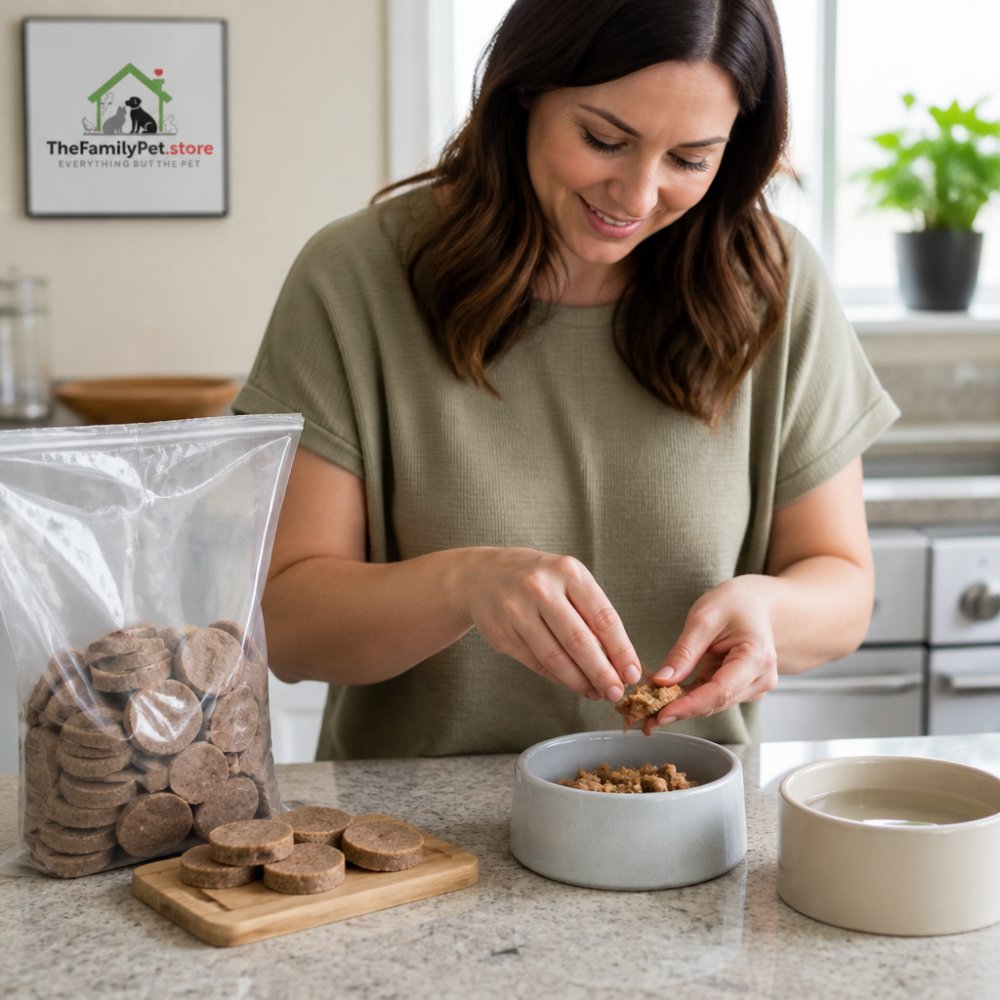
Start with about a quarter raw mixed into three-quarters of the current food and hold for two or three days. If stools stay firm and your cat keeps eating, move to half and half, then three-quarters, then full raw. If you see loose stool or refusal, drop back a step and hold longer.
A few practical notes from experience:
Vital Essentials Mini Patties Turkey Entree Freeze Dried Raw Cat Food (8oz) →
- Warm freeze-dried patties with a splash of warm water to boost aroma and hydration
- Feed at the same times and in the same bowl as before
- Don't mix in new treats during the transition; keep variables low
Key Takeaway
The transition speed should be set by your cat's digestion, not by a calendar. Some cats sail through in a week; others need three. Both are normal.
Teeth, Coat, Weight, and Energy: Grading the Evidence
Here's where we get blunt: the evidence behind individual raw diet benefits varies a lot, and it's worth grading honestly rather than treating every claim as equal. Below, each claim gets a grade, a plain-English explanation, and a way to check whether it's happening for your cat.
How to read the grades
- Strong, supported by controlled research or well-established nutrition science
- Moderate, consistent owner reports plus a plausible mechanism, but limited controlled data
- Weak, mostly anecdote, or the mechanism doesn't hold up
Dental health, Weak
Some owners report less plaque and tartar on a raw diet, and the theory is that raw meaty bones provide natural abrasion.
How to check it: Ask your vet to look in your cat's mouth at your next visit. Plaque and tartar are visible, and a professional opinion beats guessing from the outside.
Coat condition, Moderate
Many owners report a shinier coat and healthier skin on raw, likely tied to higher animal fat and protein intake and a better omega-3 to omega-6 balance. It's a common observation with a reasonable mechanism, but it's not a controlled finding, and coat condition also shifts with season and allergies.
How to check it: Take a photo of your cat in the same lighting once a month. Run your hand along the back and note whether the coat feels smooth or coarse. Compare photos side by side rather than trusting memory.
Weight management, Strong
Raw diets are often higher in protein and moisture, which can help cats maintain lean muscle and a healthy body condition.
How to check it: Weigh your cat monthly on a baby scale, and use a body condition score chart, your vet can show you how to feel for ribs and waist.
Energy, Weak
Owners frequently describe more playful, energetic cats. Whether that's the food or the extra attention during mealtime is hard to separate, and "more energy" is one of the easiest things to perceive when you're hoping to see it.
How to check it: Note how many minutes a day your cat actively plays, and whether that changes over a month. If the change is real, it should show up in a log, not just a feeling.
Hydration, Moderate to Strong
Raw food carries far more moisture than kibble, and cats are notoriously poor water drinkers. That alone can support urinary and kidney health, one of the more mechanistically solid points in favor of any wet or raw diet over dry food.
How to check it: Watch litter box clumps, more, smaller clumps usually mean more urine output. Your vet can also check urine concentration at a routine visit.
The decision framework: who should talk to a vet first
Before any switch, run through this list with your veterinarian. None of these automatically rules out raw feeding, but each one changes the conversation:
- Kittens, growing cats have different nutrient targets, and a deficiency during growth does lasting damage
- Seniors, kidney disease, thyroid disease, and arthritis change protein and phosphorus needs
- Cats on medication, some drugs interact with diet, and appetite changes on a new food can mask side effects
Track outcomes, don't just perceive them
Owners who switch successfully tend to track a few simple things rather than relying on a general sense that their cat seems better:
- Body weight, monthly, same scale
- Body condition score, monthly, using a chart from your vet
- Stool quality, daily for the first two weeks, then weekly; note firmness and odor
The throughline: raw diet benefits are plausible and widely reported, but the strength of evidence ranges from anecdotal to reasonable. Your vet knows your cat's history, and that beats any general guide, including this one.
Key Takeaway
The most useful thing you can do isn't pick the "right" diet, it's measure what's actually happening. Weight, body condition, stool, appetite, and lab work tell you more than any forum thread ever will.
Conclusion
The honest challenge with raw feeding is that it asks more of you than opening a bag: hygiene discipline, a slow transition, and a real conversation with your vet about your cat's specific needs. If you're ready for that, we can help you build a plan that fits your household. At The Family Pet, our team walks cat parents through freeze-dried and raw options every day, and our industry-leading 'Best In Show' loyalty membership program rewards you along the way.
Frequently Asked Questions
Is it good to feed a cat a raw diet?
It can be a good fit for some cats, but it is not automatically better for every cat. Owners often report smaller stools, a shinier coat, and better appetite on raw food, and a raw diet benefits cats by offering high animal protein and moisture. The trade-offs are real too: bacterial contamination, the risk of nutritional gaps in unbalanced recipes, and the need for careful food handling. Talk with your vet before switching, especially if your cat has kidney, liver, or immune concerns.
Why don't vets recommend a raw diet for cats?
Many vets are cautious because of foodborne pathogens like Salmonella and Listeria, which can affect both the cat and the people handling the food. They also see cats with nutritional deficiencies from homemade recipes that were not properly balanced. That caution is not a blanket no. Some vets support raw feeding when the recipe is complete and balanced and the household follows strict food-safety habits. Ask your own vet how they feel about it for your specific cat.
Can a raw diet improve a cat's coat or digestion?
Many owners report a shinier coat and firmer, smaller stools within a few weeks of switching, largely because raw food is high in animal protein and moisture. Digestibility and nutrient absorption can improve for some cats, and stool odor often drops. These are owner observations rather than guarantees, and results vary by cat and by recipe. Track changes with photos and notes so you can judge what is actually happening for your cat.
Is homemade raw cat food nutritionally complete?
Only if the recipe is formulated to meet your cat's nutritional needs. Meat alone is not enough. Cats need the right balance of calcium and phosphorus, taurine, vitamin A, vitamin D, and other essential nutrients, and a recipe that skips organ meat or a calcium source can cause serious deficiencies over time. Have a veterinary nutritionist review your recipe, or choose a commercial raw food that states it is complete and balanced.
How can I reduce the risks of feeding raw food to my cat?
Keep raw meat frozen until you need it, thaw it in the fridge, and never leave it out at room temperature. Wash hands, bowls, counters, and utensils with hot soapy water after every feeding, and keep raw food away from human food prep areas. Store portions in sealed containers, feed within the recommended window after opening, and skip raw feeding entirely for kittens, senior cats, or cats on immune-suppressing medication unless your vet approves.
How do I transition a cat to raw food without stomach upset?
Go slowly. Mix a small amount of raw food into your cat's current food for the first 7 to 10 days, gradually increasing the raw portion while decreasing the old food. Watch appetite, stool quality, and energy each day, and slow down if you see loose stools or vomiting. Cats can be picky, so try a freeze-dried raw option first if your cat turns up their nose at frozen raw. Always keep fresh water available.


Leave a comment