


October 25, 2026
Doug Stone
October 26, 2026
,
Doug Stone
How to Choose Natural Dog Food for Your Pet
Last Updated: October 26, 2026
Quick Summary
To choose natural dog food, look for named animal proteins like chicken or beef in the top ingredients, check the AAFCO nutritional adequacy statement, and avoid artificial colors, flavors, and synthetic preservatives like BHA, BHT, or ethoxyquin. Reading the ingredient list and guaranteed analysis matters more than trusting marketing claims on the front of the bag.
- Named animal proteins should appear in the top two or three ingredients, not vague terms like meat meal or by-products.
- The AAFCO nutritional adequacy statement confirms the food meets established nutrient standards for your dog's life stage.
- Avoid artificial colors like Red 40 and Yellow 5, artificial flavors, and synthetic preservatives such as BHA, BHT, or ethoxyquin.
- Convert wet and dry foods to a dry-matter basis to accurately compare protein and fat percentages between different formats.
- Transition to new food gradually over 7-10 days while monitoring appetite, energy, coat quality, and any signs of sensitivity.
Table of Contents
- What 'Natural' Really Means on a Dog Food Label
- How to Read Dog Food Labels and Find Quality Ingredients
- Natural Dog Food Ingredients to Look For
- Understanding Complete and Balanced Dog Food
- Matching Natural Dog Food to Your Dog's Age and Activity Level
- Transitioning Dog Food Safely and Monitoring Results
- Start Your Dog's Natural Food Journey Today
- Frequently Asked Questions
What 'Natural' Really Means on a Dog Food Label
When you see "natural" on a dog food bag, what does it actually mean, and how do you choose natural dog food that's right for your dog? It's simpler than the marketing makes it sound.
Natural dog food means the food contains ingredients that come from nature, meat, vegetables, fruits, and grains, rather than artificial additives, synthetic vitamins, or chemical preservatives. The Association of American Feed Control Officials (AAFCO) defines "natural" as a product without artificial flavors, colors, or preservatives added after basic processing.
Here's the catch: "natural" doesn't mean organic, doesn't mean the food is free of all processing, and doesn't mean it's automatically better than other foods on the shelf.
Many brands slap "natural" on their labels because it sells well, but true natural dog food goes beyond the claim, it starts with quality ingredients you can recognize.
The real test is reading what's actually inside. A natural dog food may include:
- Named animal proteins (like chicken, beef, or salmon, not "meat meal" or "by-products")
- Real vegetables and fruits listed by name
- Minimal artificial additives
- No synthetic colors or flavors
- Natural preservatives like mixed tocopherols (vitamin E) instead of BHA, BHT, or ethoxyquin
Not every "natural" label tells the whole story. Reading the label yourself matters more than trusting marketing claims.
How to Read Dog Food Labels and Find Quality Ingredients
Reading a dog food label is like learning a new language at first. Check the same five things in the same order every time so you're comparing apples to apples.
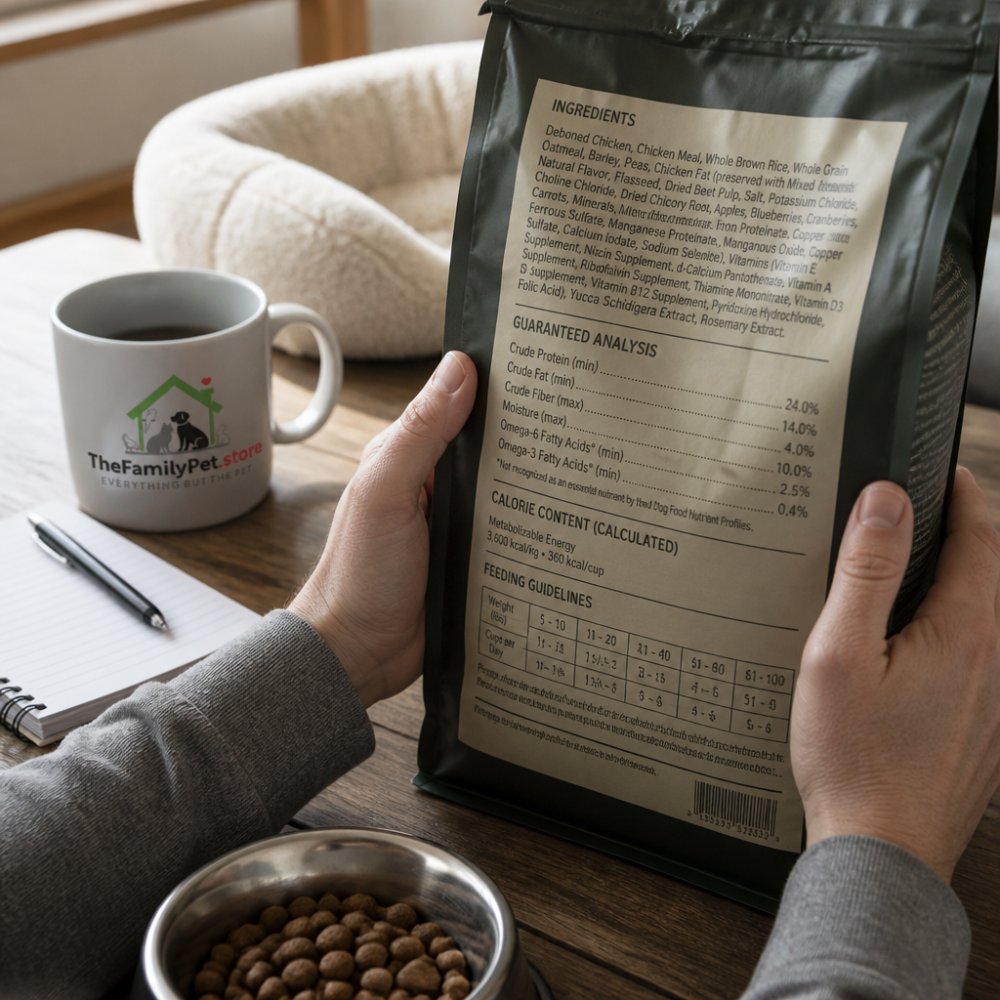
Your Five-Step Label Checklist
Work through these in order.
- Find the nutritional adequacy statement. Look for the AAFCO statement (more on that below).
- Scan the first five ingredients. You want a named animal protein in the top two or three.
- Read the guaranteed analysis. Note protein, fat, fiber, and moisture minimums/maximums.
- Find the calorie content. Look for the kcal/kg and kcal/cup (or kcal/can) figures, usually near the guaranteed analysis or feeding directions.
- Check the manufacturer information. Who makes it, and where?
Pro Tip
Snap a photo of the label with your phone.
Understanding the Ingredient List
The ingredient list is the first place to look. Ingredients are listed by weight, from most to least.
Look for named animal proteins at the top of the list. This means the label says "chicken," "beef," "salmon," or "turkey", not vague terms like "meat," "poultry," or "animal by-products."
By-products are parts of animals humans don't typically eat, like organs, beaks, and hooves.
After the main protein, look for whole foods:
- Real vegetables like sweet potato, carrots, or green beans
- Fruits like blueberries or apples
- Grains like brown rice or oats (if the food is not grain-free)
Check the top five ingredients.
One more quirk: fresh meat contains a lot of water, so it weighs more than dry ingredients like meals or grains. That's why a food can list "chicken" first and still be mostly grain by dry weight, so you can't judge a food by the first ingredient alone.
Decoding the Guaranteed Analysis
Below the ingredient list, you'll find the guaranteed analysis. This section shows the minimum or maximum amounts of key nutrients.
The main numbers to understand are:
- Crude Protein (minimum): How much protein the food contains.
- Crude Fat (minimum): Essential for skin and coat health. Most adult dogs do well with 10-15% fat.
- Crude Fiber (maximum): Helps with digestion. Too much fiber can cause loose stools.
- Moisture (maximum): How much water is in the food.
These numbers show the food's guaranteed analysis.
Comparing Foods on a Dry-Matter Basis
You can't compare the protein number on a can of wet food to the protein number on a bag of kibble.
The fix is to convert both to a dry-matter basis. It's a simple two-step calculation:
- Subtract the moisture percentage from 100 to get the dry matter. (A kibble with 10% moisture is 90% dry matter.)
- Divide the nutrient percentage by the dry matter, then multiply by 100.
Example: A canned food lists 8% protein and 78% moisture. Dry matter is 22% (100 − 78). Protein on a dry-matter basis is 8 ÷ 22 × 100, or about 36%.
Do the same for fat.
Key Takeaway
Front-of-bag claims like "high protein" or "real chicken first" are marketing.
Calorie Content: The Number Most People Skip
Somewhere on the label, often near the feeding directions, you'll find calorie content, shown as kcal/kg and kcal/cup (or kcal/can). This number tells you the calorie content of the food.
The Nutritional Adequacy Statement
An AAFCO nutritional adequacy statement may read something like: "This product is formulated to meet the nutritional levels established by AAFCO Dog Food Nutrient Profiles for adult maintenance."
There are two common versions:
Dr. Marty's Nature's Blend Essential Wellness Freeze Dried Raw Dog 16 oz →
- Formulated to meet, the recipe was designed to meet the AAFCO nutrient profiles.
- Animal feeding tests using AAFCO procedures, the food was actually fed to dogs in a controlled trial and met the standards.
Manufacturer Information and Quality Controls
Finally, look at who makes the food.
You don't need to become a food scientist, just a repeatable routine: adequacy statement, first five ingredients, guaranteed analysis, calories, and manufacturer.
Natural Dog Food Ingredients to Look For
Protein sources matter most. Named animal proteins like chicken, beef, turkey, lamb, and fish are complete proteins with all the amino acids dogs require. You can see examples in products like Smallbatch Dog Freeze Dried Small Bites Turkey, which lists turkey and turkey organs as the main ingredients.

Vegetables and fruits add vitamins, minerals, and fiber. Look for sweet potato, carrots, pumpkin, blueberries, and spinach.
Avoid these ingredients:
- Artificial colors (Red 40, Yellow 5, Blue 2)
- Artificial flavors
- BHA, BHT, or ethoxyquin (synthetic preservatives)
- "Meat meal" or "poultry meal" without a named source
- Corn syrup or high-fructose corn syrup
- Excessive fillers like corn and soy
The ingredient list is your window into what you're actually buying.
Understanding Complete and Balanced Dog Food
The phrase "complete and balanced" refers to nutritional standards set by AAFCO for a dog's life stage.
Common life-stage categories are:
- Growth (for puppies)
- Adult maintenance (for grown dogs)
- Senior (for older dogs)
- All life stages (covers puppies through seniors)
An AAFCO statement may read something like: "This product is formulated to meet the nutritional levels established by AAFCO Dog Food Nutrient Profiles for adult maintenance."
Natural dog food can be complete and balanced.
Matching Natural Dog Food to Your Dog's Age and Activity Level
Your dog is unique. What works for your neighbor's dog might not work for yours.
How Much to Feed: Start With the Bag, Then Adjust
A simple way to check body condition at home: run your hands along your dog's ribs. You should feel them easily under a thin layer of fat, like the back of your hand. If you have to press to find them, your dog may be carrying extra weight. If they're sharply visible, your dog may be too thin. Looking down from above, you should see a waist behind the ribs.
Matching Food to Common Situations
A few practical pairings: puppies thrive on natural food formulated for growth, while adult dogs do well on maintenance formulas.
Start with your dog's age and size, then adjust based on activity level and body condition. Senior dogs benefit from natural food formulated specifically for their life stage. If your dog is gaining weight, they need fewer calories; if they're losing weight or seem hungry, they might need more.
When General Advice Isn't Enough
Some dogs need more than a good all-purpose food. If your dog has food allergies, a chronic condition like kidney or heart disease, or a weight problem that hasn't responded to portion changes, talk to your veterinarian. They can rule out underlying issues and, if needed, point you to a veterinary nutritionist who can build a plan around your dog's specific needs. That's not a failure of your food choice, it's just the right tool for a different job.
Transitioning Dog Food Safely and Monitoring Results
Here's a simple transition schedule:
- Days 1-2: 75% old food, 25% new food
- Days 3-4: 50% old food, 50% new food
- Days 5-6: 25% old food, 75% new food
- Days 7-10: 100% new food
Also watch for:
- Appetite changes (eating more or less)
- Energy level (more playful or lethargic)
- Coat quality (shinier or duller)
- Itching or scratching (sign of sensitivity)
Start Your Dog's Natural Food Journey Today
Choosing natural dog food is about understanding what goes into your dog's bowl. Explore best natural dog food brands that meet the quality standards discussed here.
The journey starts with one simple step: reading the ingredient list on your dog's current food. Ask yourself: Are these ingredients I recognize? Is the main protein named? Would I eat these ingredients?
At The Family Pet, we offer a comprehensive selection of high-quality nutrition for dogs. Whether you shop online or visit us, our mission is to be your trusted partner in providing care for your companion.
Frequently Asked Questions
What does 'natural' mean on a dog food label?
On a dog food label, 'natural' is a term used to describe the food. Always check the ingredient list rather than relying solely on the 'natural' claim on the package.
How do I know if natural dog food is complete and balanced?
A package may include a statement that the food is 'complete and balanced' and refers to AAFCO (Association of American Feed Control Officials) standards. A guaranteed analysis may also show minimum protein and fat percentages, and maximum fiber and moisture.
How should I transition my dog to a new natural food?
Transition gradually over 5-7 days to avoid digestive upset. Start by mixing about 25% of the new food with 75% of the old food for the first 2 days, then gradually increase the new food to 50/50. By day 5-7, your dog should be eating mostly the new food. Watch your dog's stool quality during this time, firm stools indicate good digestion. If your dog shows signs of an upset stomach, slow down the transition or consult your veterinarian.
What should I look for in natural dog food ingredients?
Look for named animal proteins like chicken, beef, turkey, or fish as the first ingredients. Avoid vague terms like 'meat meal' or 'by-products.' Natural dog food should include whole vegetables and fruits like sweet potatoes, carrots, and blueberries rather than just grains. Check that the food uses natural preservatives such as mixed tocopherols instead of artificial ones like BHA or BHT. The ingredient list should be easy to recognize, if you can't identify what something is, it's worth questioning.
Choosing the right natural dog food doesn't have to be overwhelming. Start by understanding your dog's needs, age, size, activity level, then match those needs to a food with quality ingredients and complete nutrition. The Family Pet carries freeze-dried, gently cooked, and kibble options that meet these standards. Visit us online or in-store to explore natural dog food options and get personalized recommendations for your dog.


Deja un comentario